Literature & Guides
-
![]()
Touched by Suicide
By Michael F. Myers, M.D. and Carla Fine
Whether you are struggling with fresh grief at a loved one’s death by suicide or your loss happened years ago, you should know that you are not alone. 5 million Americans are affected—directly or indirectly—by this tragedy each year. And it sends us on a lifelong search for answers, both to the practical questions and the deepest question of all: Why? In this definitive guide book, Michael F. Myers, MD, a leading psychiatrist, and Carla Fine, author of the acclaimed No Time to Say Goodbye: Surviving the Suicide of a Loved One, combine their perspectives as a physician and a survivor to offer compassionate and practical advice to anyone affected by suicide.
-
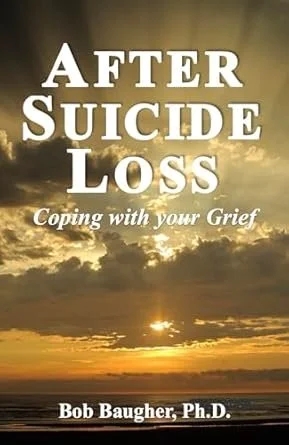
![Book cover titled 'After Suicide Loss: Coping with Your Grief' by Bob Baugher, Ph.D., featuring a sunset with clouds.]()
After Suicide Loss
Jack Jordan, Ph.D., and Bob Baugher, Ph.D., Caring People Press, 2016 (2nd edition).
This excellent handbook is organized chronologically to follow the days, weeks, and months after a suicide loss. It includes straightforward information about psychiatric disorders, when to seek professional help, and practical strategies for coping and healing.
-
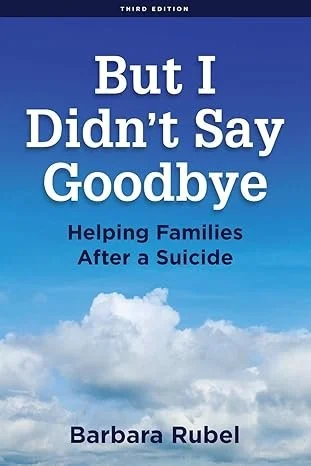
![Book cover titled 'But I Didn't Say Goodbye: Helping Families After a Suicide' by Barbara Rubel, featuring a blue sky with clouds.]()
But I Didn't Say Goodbye
By Barbara Rubel
But I Didn’t Say Goodbye: Helping Families After a Suicide tells the story, from the perspective of a family, as they are rocked by suicide and reeling from the aftermath.
The reader will see the transformation of feelings after going through death by suicide. The revised edition is an evidence-informed and contemporary treatment of a devastating form of loss that uses the artful device of a hypothetical case study to render it in human terms.
The reader will understand how to make meaning in the loss, and ways to experience personal growth. This self-help book was revised to provide guidance and education for clinicians and families to help suicide loss survivors.
-
![Book cover of 'The Suicide Club' by Alexandra Wyman featuring a dark background with white daisies and yellow centers.]()
The Suicide Club
By Alexandra Wyman
Alexandra Wyman was plunged into grief when her husband died by suicide. The sudden loss of the love of her life left her reeling with unanswered questions.
In The Suicide Club: What to Do When Someone You Love Chooses Death, Alexandra explores her journey of mourning and healing after losing her husband. She makes sense of her grief through three phases—Shock and Awe, Now What?, and Finding the Collateral Beauty—to offer a road back to peace and joy for anyone who has lost someone close to them to suicide.
The aftermath of suicide leaves loved ones in a mess of emotions. The Suicide Club shows a way forward through any anger, blame, or judgment, toward acceptance and peace. -
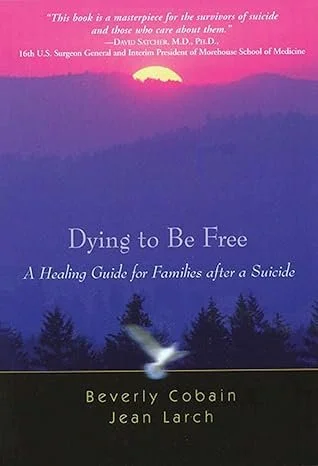
![Book cover titled 'Dying to Be Free: A Healing Guide for Families after a Suicide' by Beverly Cobain and Jean Larch, with a pink and purple sunset over a forest silhouette and a white dove at the bottom.]()
Dying to be Free
Beverly Cobain and Jean Larch, Hazelden Foundation, 2006.
Co-authored by a crisis intervention specialist and a cousin of Kurt Cobain, the lead singer of the band Nirvana who took his life in 1994, this book combines personal accounts from loss survivors with practical guidance for coping with suicide loss.
-
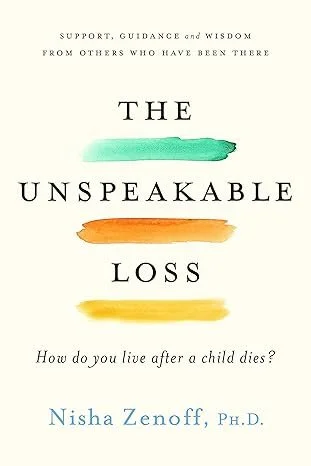
![Book cover titled 'The Unspeakable Loss' by Nisha Zenoff, Ph.D., with watercolor stripes in green, orange, and yellow.]()
The Unspeakable Loss
By Nisha Zenoff PH.D.
Nisha Zenoff lost her son in a tragic accident when he was just seventeen years old. Now, with decades of experience as a grief counselor and psychotherapist, she offers support and guidance from her own journey and from others who have experienced the death of a child. The Unspeakable Loss helps those who mourn to face the urgent questions that accompany loss: "Will my tears ever stop?" "Who am I now without my child?" "How can I help my other children cope?" "I lost my only child, how do I live?" "Will my marriage survive?" "Will life ever feel worth living again?"
-
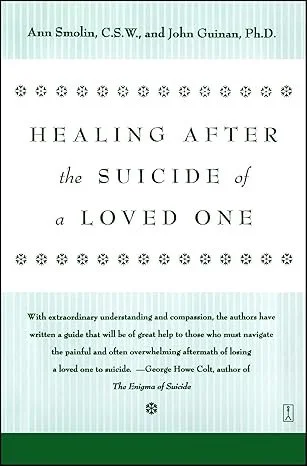
![Book cover titled 'Healing After the Suicide of a Loved One' by Ann Smolin and John Guinan, featuring a white background with decorative black floral borders and green section at the bottom.]()
Healing after the Suicide of a Loved One
Ann Smolin and John Guinan, Simon and Schuster, 1993.
Many survivors struggle with the questions “why?” and “what if?” This book shares case studies and offers advice to help survivors begin to heal.
-
![Book cover titled 'Silent Grief: Living in the Wake of Suicide, Revised Edition' by Christopher Lukas and Henry M. Seiden, featuring a red boat on calm water with a cloudy sky in the background.]()
Silent Grief: Living in the Wake of Suicide
By Christopher Lukas and Henry M. Seiden, Ph.D.
As they explore common experiences of bereavement, grief reactions, and various ways of coping, the authors emphasize the importance of sharing one’s experience of “survival” with others. They encourage loss survivors to overcome the stigma or shame associated with suicide and to seek outside support.
-
![Book cover titled 'No Time to Say Goodbye: Surviving the Suicide of a Loved One' by Carla Fine.]()
No Time to Say Goodbye
By Carla Fine
With No Time to Say Goodbye, she brings suicide survival from the darkness into light, speaking frankly about the overwhelming feelings of confusion, guilt, shame, anger, and loneliness that are shared by all survivors. Fine draws on her own experience and on conversations with many other survivors--as well as on the knowledge of counselors and mental health professionals. She offers a strong helping hand and invaluable guidance to the vast numbers of family and friends who are left behind by the more than thirty thousand people who commit suicide each year, struggling to make sense of an act that seems to them senseless, and to pick up the pieces of their own shattered lives. And, perhaps most important, for the first time in any book, she allows survivors to see that they are not alone in their feelings of grief and despair.
-
![Book cover titled 'The Forgotten Mourners: Sibling Survivors of Suicide' by Madaline Halous DeSousa, featuring a woman kneeling in snow holding a bouquet of flowers near a cemetery.]()
The Forgotten Mourners
By Magdaline Halous DeSousa
This book is meant for anyone who has lost a brother or sister to suicide - and those who want to support them. Any loss is difficult, but a loss to suicide is heightened because of the helplessness and confusion surrounding it. A sibling loss to suicide is even more unique because the sibling(s) left behind are often forgotten - mourning the loss of their brother or sister alone in the shadows of their parents' grief.
This book discusses some of the distinct challenges sibling survivors of suicide face. -
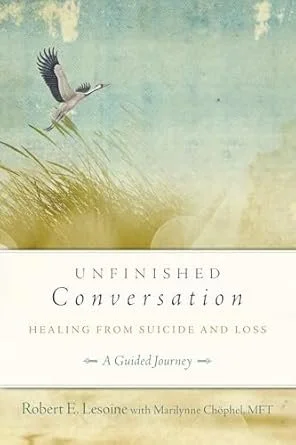
![Book cover titled 'Unfinished Conversation: Healing from Suicide and Loss, A Guided Journey' by Robert E. Lesoine with Marjynne Choephol, featuring a bird flying over grass against a soft, textured background.]()
Unfinished Conversation
By Robert E. Lesoine with Marilynne Chöphel, MFT
Unfinished Conversations is not only a story of profound grief, but also a guided journey to healing. Based on a journal Robert Lesoine kept during the two years following the suicide of his best friend, Unfinished Conversations will help readers through the process of reflecting on and affirming the raw immediacy of survivors’ emotions. Each short chapter focuses on a different aspect of the author’s experience as he transforms his anger and guilt to understanding and forgiveness.
The tools and techniques in Unfinished Conversations will help readers release past trauma, honor their relationship with their lost loved one, and find greater perspective, meaning, and well-being in their lives.